Paradise Lust by Brook Wilensky-Lanford
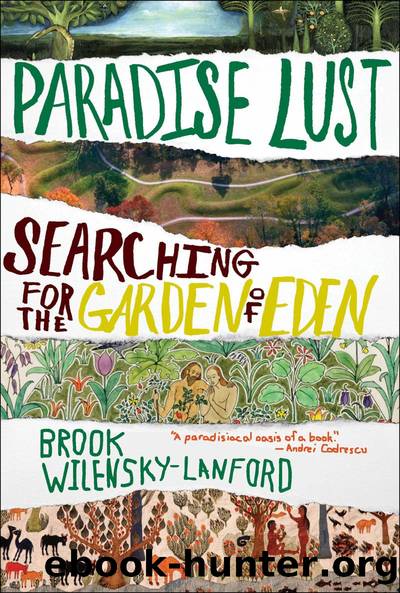
Author:Brook Wilensky-Lanford [Wilensky-Lanford, Brook]
Language: eng
Format: epub
Tags: History, Social History
ISBN: 9780802195630
Google: AucnMV_ZsWYC
Publisher: Open Road + Grove/Atlantic
Published: 2011-08-02T00:43:13+00:00
9
Mother Eveâs Great Decision
IN THE BEGINNING, Adam didnât know what to do with himself in Eden. He just sat there all dayâidle, naked, unemployedâunder a Florida grapefruit tree. God had given him immortality, so what was the rush? One day, though, he realized he needed more from life. And thatâs when Eve showed up.
On Elvy Edison Callawayâs hand-drawn map of northwest Florida, the Jim Woodruff Dam over the Apalachicola River looks like the narrow wrist of a giant hand. Just north of the dam, near the Florida-Georgia border, the Apalachicola splits into four fingers. Callaway has neatly labeled each river with its Florida name and its Biblical name: The Chattahoochee would be the Tigris, Fish Pond Creek the Pishon, Flint River the Gihon, and Spring Creek the Euphrates. In 1956, Callaway, a bespectacled lawyer who had been born in Alabama, announced that this four-river system âproves beyond all doubt that the Bible account is true, and that the Garden was in the Apalachicola Valley of West Florida.â Callaway spent the next thirty years trying to convince the world that heâd found paradise in the flat piney swamps of the Florida panhandle. He knew this was a hard sell. But he figured he could convince the skepticsâafter all, heâd been one himself most of his life.
Biblical truth was not the message one would expect to hear from a man who was named after the father of American invention, Thomas Alva Edison, and who, as a lawyer, had taken Clarence Darrowâs side in the legendary Scopes trial. Callawayâs skepticism about religion extended all the way back to his youth. It began with a girl.
Back home on the farm in tiny Weogufka, Alabama, young Callaway had wanted little to do with his fatherâs hard-line Baptist church, and he wasnât afraid to make his feelings known. Just before Christmas 1908, when Elvy was eighteen, a young female schoolteacher arrived in town. She was boarded in a respectable Weogufka household, but was not yet a member of Elvyâs church. Still, he saw no harm in befriending her and transporting her in his horse-drawn buggy to local (non-Baptist) square dances.
Since Baptists were forbidden by their church to actually dance, Callaway would simply âtake a seat in the corner and look on.â But after several nights as a spectator, speculating all the while on the relative morality of dancing, he âfinally reached the conclusion that any God who would condemn a young man to eternal damnation for what appeared to me an innocent amusement was a monster instead of a loving father.â
Callaway did not pretend this was an entirely theological point. âMy interest in the young lady helped me to reach this decision.â And he âentered whole-heartedlyâ into the dance for the next three weeks, throughout the Christmas holidays, until the fourth Saturday of January, when, his father insisted, he had to go to church. After a ninety-minute sermon on âthe pearly gates and golden streets,â the preacher opened the floor to the congregation, and somebody said what everybody was thinking.
Download
This site does not store any files on its server. We only index and link to content provided by other sites. Please contact the content providers to delete copyright contents if any and email us, we'll remove relevant links or contents immediately.
Fangirl by Rainbow Rowell(9228)
How to Bang a Billionaire by Alexis Hall(8145)
Wonder by R. J. Palacio(8097)
The Thirst by Nesbo Jo(6932)
The Space Between by Michelle L. Teichman(6929)
Assassin’s Fate by Robin Hobb(6199)
Wiseguy by Nicholas Pileggi(5770)
The Night Circus by Erin Morgenstern(5217)
Paper Towns by Green John(5177)
The Kite Runner by Khaled Hosseini(5170)
Bittersweet (True North #1) by Sarina Bowen(4843)
Gerald's Game by Stephen King(4641)
Too Much and Not the Mood by Durga Chew-Bose(4337)
Pillow Thoughts by Courtney Peppernell(4271)
Goodbye Paradise(3799)
Twelve Days of Christmas by Debbie Macomber(3559)
Good by S. Walden(3548)
The Rosie Effect by Graeme Simsion(3460)
The Cellar by Natasha Preston(3334)
